
(nearly) Free Money™
Odd-Lot Tender Offer idea

Let me ask you a question:
Do you like making money?
I bet your answer is “yeah, sure!”
Here’s another question then:
Do you like making money quickly?
You’d probably say the same thing.
How about making money quickly, and with low risk?
I’m pretty sure you do.
I mean, who doesn’t, right?
The only problem is that money doesn’t really grow on trees.
There’s no free lunch, as they say… right?
What if I told you that it’s actually… wrong?
Dirtcheapstocks posted this on Twitter the other day:
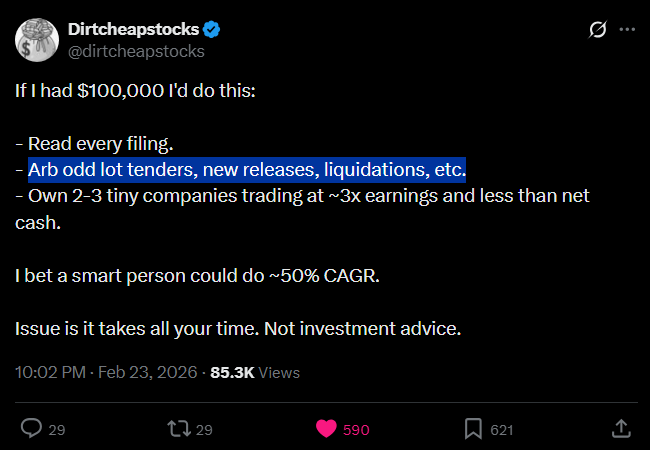
And I absolutely love it!
But you might casually read that post, leave a like, and simply go on to the next thing…
…completely unaware of the fact, that Dirt literally gave you a recipe for a (nearly) free lunch™!
“Are you mad, Stonks?” is probably what you’re thinking right now.
And to that I say:
Yeah, I’m a deep value investor! Of course I’m bat-shit crazy!
But truth be told, (nearly) Free Money™ actually exists.
I’m talking about odd-lot tenders.
Note: this opportunity is a very low risk, high reward idea, but available only to small personal accounts, as the maximum payout is capped (as is the case with odd-lot tenders in general).
In a regular tender offer, a company basically says:
“I’ll buy back shares from you at $X per share, spending up to $Y total.”
The offer is usually done at a premium to market price, so shareholders can tender their shares to potentially make a profit.
But there’s usually a catch:
Tender offers are nearly always limited by a fixed number of shares / fixed dollar amount.
Imagine a company announcing it wants to buy 1 million shares for $5 a piece, with the stock trading at $3 on the market.
What would you do?
You’d buy every share you can below $5, because that’s basically instant profit.
The problem is, everyone else is thinking the same thing.
If tender offers were free money, they soon wouldn’t be free money. Get it?
So if the offer is attractive, you usually get more shares tendered than what the company actually wants to buy.
Company wants 1.0M shares, but 1.5M shares show up.
What happens then?
It’s oversubscribed, so not everyone gets taken out fully.
Simple.
In tender offers, companies typically accept shares pro-rata, meaning everyone gets scaled down.
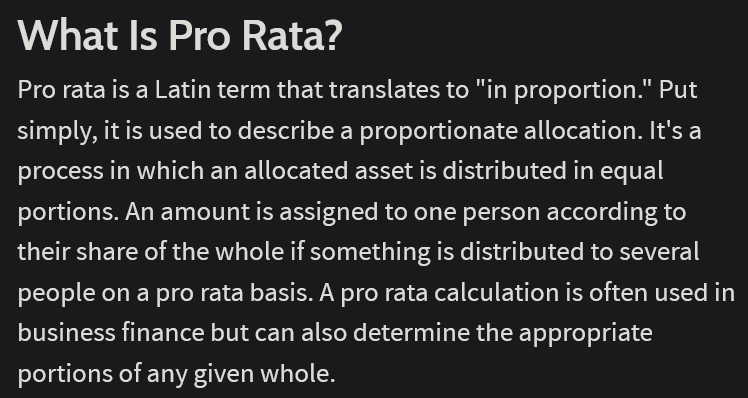
And that pro-rata mechanic is the main reason why most tender “arbs” are not free money.
But in some cases, it can get very close.
Enter: The Odd-Lot Provision
In some rare cases, tender offers include an odd-lot provision, meaning shareholders who own fewer than 100 shares (meaning 99 or less) are accepted without proration.
In other words, the company is basically saying:
“If you own <100 shares, we’ll take you out first, at a guaranteed price.”
Sounds great, doesn’t it?
So why would a company do this?
Because small accounts are administrative clutter.
Odd-lot priority is a good way to reduce that clutter.
Essentially, having thousands of tiny holders on the register puts outsized admin costs on the company, which make it incentivized to buy these “small holders” out fully.
And because the odd-lot threshold is usually <100 shares, the maximum payout is tiny.
Too tiny for any serious institutional player to care.
That’s where the edge is.
A quick example:
Stock trades at $55. Company tenders at $65.
Buy 99 shares around $55
Tender them at $65
Make $10/share (before fees/taxes)
Is it scalable? No.
Is that the point? Also no.
If you’re running a huge portfolio, this won’t move the needle.
But if you’re running a small personal account?
It absolutely can.
This is one of the few setups where institutional capital usually can’t (or won’t) compete, because the trade is effectively capped.
This is what it looks like in real life:
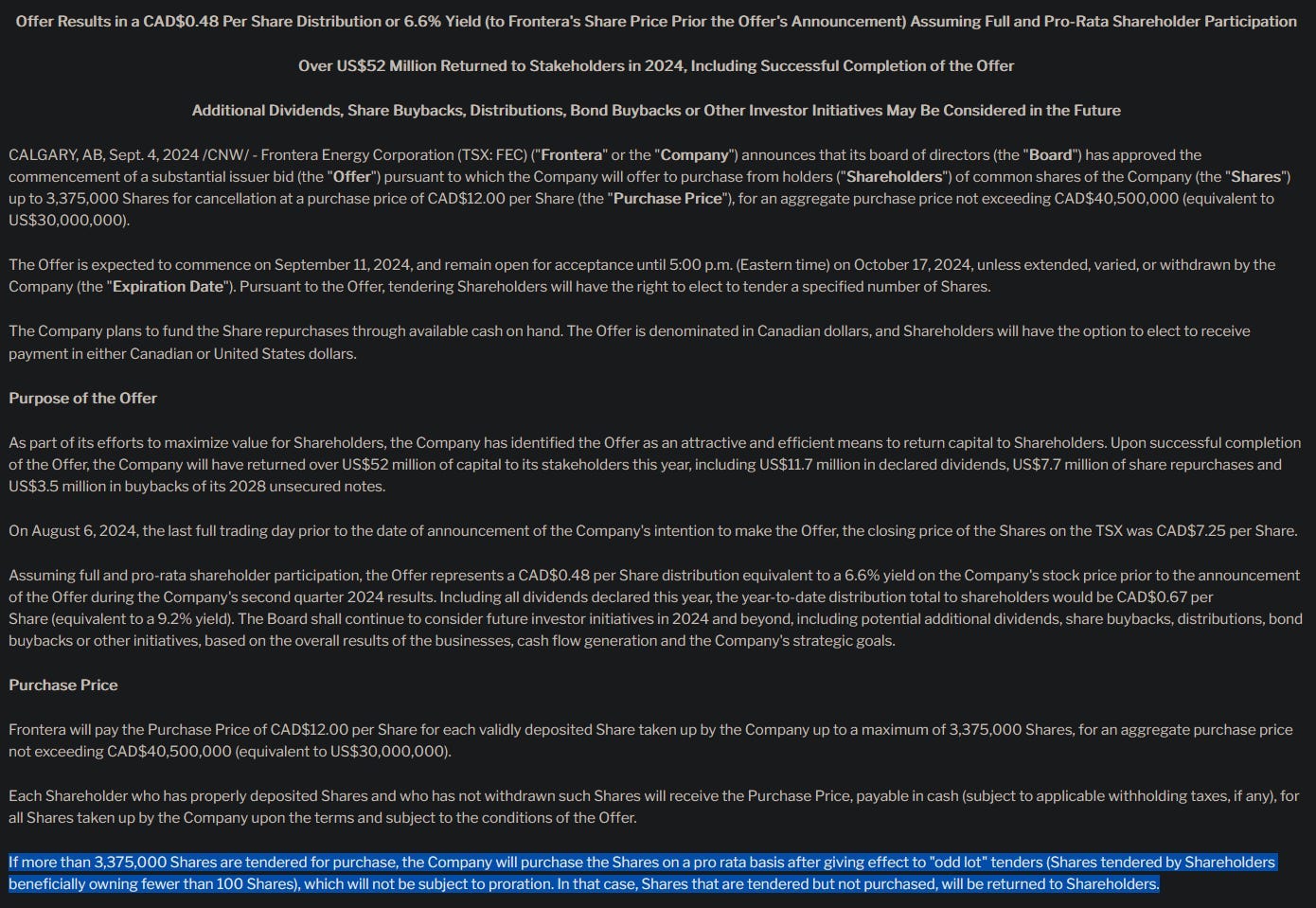
If you’re working with small capital, odd-lot tenders are exactly the thing you should be looking at.
And it’s exactly the thing Dirt was talking about.
In this article, I’m sharing an opportunity just like that.
This is probably the best play out there right now.
Interested in making (nearly) free money?
Then let me introduce you to…